Tolworth United Reformed Church
Everyone is welcome here at Tolworth United Reformed Church.
Tolworth United Reformed Church
  • Home
  • About
    • Who Are We?
    • Location
    • Worship Times
    • What to Expect
    • Baptisms, Weddings and Funerals
    • The United Reformed Church
    • Church History
  • News
    • News
    • Church Newsletters
  • What’s On?
    • Calendar
  • Church Life
    • Sunday Morning Worship reflections
    • Mission
    • Children and Youth
    • Adults activities
    • Sermons.
    • Prayers
    • Bible Study
  • Community
    • Regular Activities
    • Using the Premises
    • Links
  • Contact us

Worship series at Tolworth United Reformed Church

For our Sunday worship on in the mornings service next year we will be  doing something a little different.  In discussion with Mr Mark Dennis, a regular worship leader at Tolworth as well as around the SYNOD,  we wondered if it would be helpful to a theme for a serious of our acts of worship together.

For two Sundays each month between January and April, just after Easter Mark and I will alternate (almost) leading worship on the theme of Being Church with reflection and reference to the Gospel of Mark.

Mark’s gospel was (almost) certainly the first gospel written.  As well as being closest to the life of Jesus, the narratives, teachings and stories would have been verbally handed on in the earliest of church life and communities.

You may remember a few years ago we embarked on planning and strategy using the work from the Robert Warrens books on spirituality and Mission in the local Church, Being Human, Being Church.  We have continually reviewed this strategy but it is probably good time to re-visit and re-do the plan and strategy again.

Perhaps this worship series would be a good place to start this.  It is certainly the right way around.  Worship and prayer comes first, then we can together seek what God is calling us to again…

We hope you will find the series helpful in our walk with God day by day as well as helping us as a faith community discern afresh  God in our midst.

Sunday series at Tolworth

January to April 2026

Being Church – Lessons from Mark’s Gospel

January 11             Session 1     Preparing the Way                                               Mark 1: 1-13  Isaiah 42: 1-9

January 18             Session 2     Responding to challenges                                 Mark 2: 1-17; 23-28         Isaiah 49: 1-7

February 01            Session 3     Responding to Jesus                                          Mark 3: 7-35  Micah 6: 1-8

February 15            Session 4     The emerging church                                         Mark 4: 1-20  Exodus 24: 12-18

[February 22 – Lent 1]

March 08                Session 5     Preparation and proclamation                           Mark 6: 1-13 Exodus 17: 1-7

March 15                Session 6     Being human: the way of the Cross                     Mark 8: 27-37        1 Samuel 16: 1-13

March 22                Session 7     The Gravity of the situation                                  Mark 10: 17-31  Ezekiel 37:1-14

[April 5 – Easter Day]

April 12                  Session 8     Forward in faith: the greatest commandment   Mark 12: 28-34  Psalm 16: 1-11

Preparing the Way Mark 1: 1-13 Isaiah 42: 1-9

Sermon Mark 1: 1-13   Introduction SERMON ONE-New Hope

 Sunday 11th January 2026

I am sure you have all read and digested Concord for January.  And can I say, in Ian’s absence that as a church magazine it is wonderful- there are 8-9 contributors week by week. This really good.  Keep it up and anyone else who wants to add stuff, Ian, I am assured wants it!

You would have read that we are beginning something new and different in worship this year.  We thought we would try a Sermon Series, based on a single theme over 3 months.  Mark Dennis and I, for three months, twice each month will lead worship and deliver a sermon themed series.

And the theme we have selected is Being Church, Being a Healthy Church based on the work of Robert Warren and will reflect and explore this theme using gospel of Mark.

I may add that we used Robert Warrens work  six years ago to help us plan and develop a strategy.  It is time to do this again.  So following the sermon series, after Easter we can again, as church to go through this process again. We will begin after Easter – and your “hopes for the church” we did earlier will be the starting point!

But for now, today, I will be introducing the theme and using the work of Warren from his book, Being Human, Being CHURCH – becoming a Healthy Church – whatever that is!

What do you think? Wealthy. We need money to function.  Well organised.  Everything in order!  Maybe it is the “people” I hear you say.  So is a healthy church lots of people.  A large worshipping congregation on Sunday morning. AND all getting on and being friendly!  Maybe having lots of young families and lots of children’s work to ensure we are here in the future!  What about being part of the community and helping and healing those in need.  Jesus did a lot of this!  OR fighting and standing up against injustice.  Jesus did a lot of this too. How about loving and caring for Gods creation and sustaining a world for the future makes. Is this a sign of a healthy church.

In preparation for our sermon series and how Mark’s gospel helps us with this sermon series, we begin in a good place. Mark’s gospel is a good place to start.

John the Baptist preparing the Way for Jesus. That is a good start surely.  Mark quotes Isaiah from a time when Gods people when in trouble in exile in Babylon! (Just a little earlier than our Hebrew reading from Isaiah today).  “I am sending a messenger” and Mark has John the Baptist as that messenger. Preparing people to meet God… In exile in Babylon, not a people resilient and bold, courageous hard working. But a community seeing how the world had changed for them, a struggling group and apparently having lost a sense of hope. In  the midst of this, there is hope, in Gods coming among them.

Unlike us, John the Baptizer is a wild and woolly character. But like us, he lives to point people to one who is greater than himself. John is the first Christian in the sense that he is the first who gives witness to Jesus. And so, beings the ministry of Jesus first with his baptism, “when the spirit descended upon him” and secondly when that same spirit drove him into the wilderness, its challenge and struggle.

Maybe this gives us a clue as to what our preparations for this sermon series and what a heathy church is about.

Wanting to  point people to God, appreciating how the  Spirit changes in us and drives us to this challenge.

In his Book Robert warren introduces the theme for us.

He describes  the church as needing a service. Like a car It has been on the road for almost two thousand years without servicing or overhaul!

He reflects on the change in society and community. Some for good.  Over this century the end of apartheid, peace on Northern Ireland, the Berlin Wall – and as examples of raising the humble, Marys song of in the Magnificat we find Nelson Mandela and Mother Theresa et al.

But, although a different time, the upheaval from conflicts persist today. Then, when the book was released as now, we have been largely powerless in the face of change.

And today we can see the polarisations of political positions, and local people caught up in the divisions created in and around the world.

Here is the mission field into which the church is a called and warren quotes John Westerhof, “Living in Faith in community” when he says, the purpose of the church is to manifest an alternative way of seeing and living life – that is to make this real! In preparation for our sermon series this is our brief introduction to Robert warrens book!

Also, we are introduced to the gospel of Mark for our sermon series.  Almost certainly the first of the four gospels written. Was it an account of Jesus life, like biography?  A history perhaps? Related to our introduction to this sermon series on church, the gospel was written for the earliest of Christian communities in change.

In the first 40-60 years  after Jesus crucifixion the new community of Jesus were convinced that Jesus’ return would occur in their lifetime. There was no need to write things down, Jesus would return and gather them up to heaven.  They celebrated the life of Jesus is story telling.

The early folk came to worship God and tells stories of Jesus.  These were almost first hand!  And even as these early folk were increasingly in danger from Rome and religious elite, they met in secret in the catacombs and told the stories.  These stories were handed down word of mouth.

Of course at some time came the realisation, as older parents passed away, that Jesus return would not be in the way first thought. But  they nonetheless  held onto Jesus teaching, and so at some stage possibly 60-75 years after Jesus life on earth, these stories were written down.

Many of the passages are found in both Luke and Matthew and so Marks gospel must have been used to write them.  Making these stories in of Mark as close to the life of Jesus as we can get.

That also means that this is as close to the human life of Jesus as we come. At Christmas with all the angels, and especially at Easter we often quickly jump to Jesus divinity, Jesus is GOD and ignore his human joy, despair, regret fun and laughter suffering – the human Jesus.  If Jesus were not fully HUMAN, with all the frailty, vulnerability, weakness we experience ourselves day by day, what kind of God is God I ask?

Which finally brings us back to the community in which the gospel of Mark was written. If you put all the stories of Jesus together, his life would last 4 weeks.  The first half of the gospel are largely stories of things Jesus did his healing, and the second half his teaching mostly the disciples.

So the gospel was for this new community, that was written in a time of upheaval and change  to make real an alternative was of seeing and living life…where have we heard all that?

It is kind of where we are now. As we begin this series we have been prepared for the theme and for the gospel, how we can tell the stories and make real God in our lives and lives of those around.  Maybe this series will help us in this venture.


Responding to Challenges Mark 2: 1-17 & 23-28

MARK’S GOSPEL : RESPONDING TO CHALLENGES  Readings: Mark 2: 1-17 & 23-28

 Sunday 18th January 2026

Introduction

We are continuing our exploration of Mark’s gospel this morning.  This gospel was written down about 60 years after the birth of Christ.  It is the earliest and most direct account that we have of the life, death and resurrection of Jesus Christ.

I wonder if you noticed a common theme in our reading from chapter 2 of Mark’s gospel?   Well, the stories in this chapter are all about the same thing.  How Jesus dealt with challenges.  And how Jesus dealt with challenges is important for us.  Why?  Because there are people and forces today still opposed to the teachings of Christ; and the advancement of the kingdom of God. Part of the purpose of this series of sermons is to help us build up the church.  And to help us build up the kingdom of God.  That means we need to know for ourselves how to deal with the kind of challenges that Jesus Christ faced.

Let’s see how challenges to Christ develop in Mark’s gospel.

First, the challenges are in people’s thoughts.  Then they become comments and questions to the disciples.  Finally, there is direct and deliberate attack.  This is more-or-less the same way that challenges and opposition always develop. First, thoughts.  Then comments to other people.  Finally, (if the feeling is strong enough) direct action.

What were the challenges that Christ had to deal with?  In chapter two of Mark, the religious leaders were opposed to Jesus for three main reasons:

Firstly, because of the claims he made; especially (verse 7) to forgive sins.

Secondly, because of the company he kept especially (verse 16) in eating and drinking with tax-collectors and sinners

And thirdly because of the customs he ignored; especially (verse 24) keeping the Sabbath

We’ll look at these, briefly, in turn.

 The claim to forgive sins (2: 7)

This is one of the Bible stories I remember from childhood (2: 3-5).  These four men taking off the roof from the house and lowering their paralysed friend down through the opening. (I must have been a destructive child!)   It must certainly have been a very dramatic event.

How does Jesus respond?  Well, he deals with the real roots of this man’s sickness.  True health is being in a right relationship with God.  And Jesus meets the man’s deepest need when he says: “My son, your sins are forgiven”.  Not what he expected; but certainly what he needed.

We need to remember that Jesus came from God, into this world, to confront, and deal with, evil in all its forms.  Sickness and disease are consequences of humankind’s sinful condition; and it is this condition that Jesus came to deal with.

And, of course, the teachers of the law; well, they are understandably upset by this.  Their response is perfectly proper.  Only God can forgive sin.  Consequently, Jesus is guilty of blasphemy.  There was an alternative explanation; but their eyes were blind to it.  Namely, that Jesus could, indeed, speak for God; because he was God incarnate.

Let me read a few words from C.S. Lewis on this claim by Jesus Christ to forgive sins, because they are very helpful (from ‘Mere Christianity’)

 “This is really so preposterous as to be comic.  We can all understand how someone forgives offences against themselves.  You tread on my toe; and I forgive you.  You steal my money and I forgive you.  But what should we make of someone, themselves unrobbed and untrodden on, who announced that they forgave you for treading on other people’s toes and stealing other people’s money?  Asinine fatuity [completely bonkers in modern language!) is the kindest description we should give of their conduct.  Yet this is what Jesus did.  He told people their sins were forgiven.  He never bothered to consult all the other people who their sins had undoubtedly injured.  He unhesitatingly behaved as if he was the person chiefly concerned; the person chiefly offended in all offences.  

 This makes sense only if he really was the God whose laws are broken and whose love is wounded in every sin.  In the mouth of any speaker who is not God, these words would imply what I can only regard as a silliness and conceit unrivalled by any other character in history.

 That was C. S. Lewis writing in the 1940s.  But in the time of Jesus’s ministry on earth, the teachers of the law; the Pharisees; they simply could not accept that Jesus was God.  They couldn’t accept it.  This is why they were opposed to Jesus.  And this is why they challenged him.

They were not bad people; they weren’t evil; but they became opposed to the work that Jesus did.  And it is still easy today for good people; religious people to resist, and become opposed to, some new work of God.  The challenge to us is to not fall into that trap.

  1. The company he kept (2:16)

So the claim that Jesus made to forgive sins; that generated opposition.  And, then, the second thing in Mark 2 was the company that he kept.

We see (verse 14) how Jesus called Levi to become one of his disciples.  (His other name was Matthew; and he is the Matthew of the first gospel).  But, when Jesus called him, he was a tax-collector.

Let us be quite clear, in Britain today, taxation is necessary to pay for essential services.  So tax-collectors, on the whole, are good people.  But at the time of Jesus, these tax-collectors were loathed.  They were working on behalf of an invading power; and they were notoriously dishonest.

We may be surprised that Jesus would want someone like Levi in his team.  But, according to Mark, Jesus clearly calls him. Directly and personally the call comes (v. 14); and Levi responds immediately.  And then, presumably as a spontaneous expression of joy, Levi throws a party for all his old friends (v. 15).  We can imagine every rogue – let’s go no stronger than that – every rogue in the area being there, shoulder-to-shoulder with Jesus.  Levi wanted to honour his new-found Master – and give others the chance to meet him.  We hear a lot about evangelism in the church, don’t we?  Well, Levi seems to have actually got on and done something about it.

When the Pharisees get to hear about this – they are scandalised.

Jesus mixing with all this rabble.  They think it is disgraceful.

But Jesus responds by saying that it is not those who think they’re OK who need help; but those who know they are not.  And he uses the memorable expression: “It is not the healthy that need a doctor, but those who are ill.”

But the Pharisees simply could not accept that they, as much as anyone else needed God’s forgiveness.  They couldn’t accept it.  This is another reason why they challenged Jesus.  They weren’t bad people or evil people; but neither were they themselves without sin.  They couldn’t accept this; or realise it; and so their opposition to Jesus grew.

And, again, it is still easy today for good people; religious people to resist, and oppose, God’s work.  God may have tremendous plans for us and our church, our community, our nation and our world.  The challenge to us is to work with God; and not in opposition to him.

  1. The customs he ignored (2: 24)

So, we’ve heard how the claim that Jesus made to forgive sins generated opposition.  And, then, how the company that he kept added to the opposition.

Finally, we come to what was, probably, his most serious failing in the eyes of the Pharisees; and that is the customs he ignored.  In particular, observance of the Sabbath.  We saw in chapter 2 (v. 23) how he allowed his disciples to pluck ears of corn on the Sabbath.  That incident is complemented by another at the beginning of chapter 3, where Jesus heals a man – on the Sabbath.

Once again, when the Pharisees see these events they think it’s appalling.

For them, observance of the Sabbath was a very important custom.  To see it flouted in this way was terrible.  And Jesus responds with another of his memorable expressions: “The Sabbath was made for the sake of man; not man for the Sabbath”.  The Pharisees wanted the security of rules and regulations and laws to tell them what to do and not to do.

Jesus begins to show them a new revolutionary way; the way of personally responding to God; and how God loves people more than rules.

Rules have their limitations.

Legislation almost always requires definition.

Often the law is quite useless.  A tragic example is seen in cases of two babies born as Siamese twins; two babies physically joined together.  Judges sometimes have to decide whether they should be surgically separated – against the wishes of their parents – to try and save the life of the stronger twin; while ending the life of the weaker child.

The law is quite useless to those parents and their children in that situation.

And so the message of Jesus is quite clear: people matter more than rules, customs and laws.

Conclusion

We have seen how Jesus dealt with challenges.  How can this help us to deal with those who challenge and oppose him today?  What Jesus does is to get behind petty criticisms of points of detail to fundamental truths that are at the heart of existence.   Truths like these:

True health is not a matter of our physical condition : it is a question of whether our relationship with God is healthy.

It is not the healthy that need a doctor, but the sick.

People are more important than rules and laws.

Jesus brings new light to shine on God’s relationship with us and all people; and new light on our relationship with God.  The challenge to us is to live our lives so that they reflect his teaching.

Responding to Jesus Mark 3: 7-35

MARK’S GOSPEL : REACTIONS TO JESUS


Reading: Mark 3: 7-35; Micah 6: 1-8


Introduction


We are continuing our exploration of Mark’s gospel this morning.  This gospel was written down about 60 years after the birth of Christ.  It is the earliest and most direct account that we have of the life, death and resurrection of Jesus Christ.


Does chapter 3 of Mark’s gospel have a common theme running through it?   Really, it is about how different people reacted to Jesus Christ when he was at work among them.  There’s no doubt that Jesus Christ provoked strong reactions among people; and he still does today.  Christianity is the fastest growing religion in the world.  Perhaps it seems unlikely to us here this morning; but in many parts of the world churches are growing rapidly.


So let’s look at the reactions to Jesus we find in chapter three of Mark.


  1. Jesus among the crowds (7-12)


You might remember, when we looked at chapter 2 of Mark, we saw that Jesus faced considerable opposition from the religious leaders of his time.  In chapter two, we saw that there was opposition to Jesus for three main reasons:


Firstly, because of the claims he made; especially to forgive sins.


Secondly, because of the company he kept especially in eating and drinking with tax-collectors and sinners


And thirdly because of the customs he ignored; especially keeping the Sabbath.


So it is not surprising to find in chapter 3 that Jesus leaves the towns and cities and synagogues and all the establishment and goes out into the countryside.  Perhaps he wanted to “get away from it all”.  Who hasn’t felt like that on occasions?


But, actually, Jesus wasn’t terribly successful at getting away from it all. We read (3: 7) that a large crowd followed him.  And there’s one of those lists of place-names of which the Bible is so fond (3: 8).


We can see from this that what Jesus offered was attractive to a lot of people.  There’s no doubt about that.  The question for us is: ‘How can we present Jesus in a way that is attractive to people in our own time?’


2


  1. Jesus chooses his team (13-19)


So, Jesus goes out into the countryside; to the lakeside; and then, still, presumably, seeking some solitude, he goes up a hill or mountain (v.13).  And then he draws together a team of people – his disciples – through whom he intends to work.


It is significant that Christianity began with a group.  Did you notice that? The Christian faith is something which, from the beginning, had to be discovered and lived out in a fellowship.  It is a group activity.


Group activities aren’t as popular as they used to be

e.g. individual fitness machines replacing squash courts.


Fewer murders in London because people go out less!


People do more and more things on their own.


That is an aspect of society which presents a challenge to the traditional way in which churches have functioned.


But we see very clearly in the New Testament that Jesus worked with a group; and, therefore, Christianity ought not to be a solitary activity.


We’ll just mention the fact that they were a very mixed group, without really going into the details of that.  Suffice it to say that between them there were all sorts of backgrounds and opinions.  But the disciples had two special qualifications.  First, they felt the attraction of Jesus.  There was something about Christ that made them want to follow him.  Secondly, they had the courage to show that they were on his side.


These twelve had all kinds of faults and failings – just like us!  But – whatever else could be said about them – they loved Jesus Christ.  And they were not afraid to tell the world that they loved him.  And, really, that sums up what being a Christian is all about.


Why did Jesus call disciples anyway?  Two reasons, really.  They are given in verse 14.  He called them to be with him; and he called them to send them out.  That may sound contradictory.  But that is the balance which all Christians (including us) have to strike.


It’s nice to be ‘with Jesus’, isn’t it?  Listening to his words, praying to him, secure in his house, the church.  We feel that we are spending time in the presence of God and among friends.  All very comforting.  And there is nothing wrong with that.  Jesus calls us to be with him.


But he also calls us so that he can send us out.  That’s the bit that the church finds difficult.  Getting out, where the action is; and communicating the love of God in Jesus Christ to people.


3


There have been endless discussions about evangelism and outreach and mission.  This church is using a book, ‘Being human, being church’ to help develop its strategy for the future.


That book is sub-titled ‘Spirituality and mission in the local church.’  And it’s a good book.  But it will count for nothing if the ideas it contains aren’t put into practice.


  1. Jesus deals with evil (22-30)


We then come to some rather confusing verses (22-30) in which Jesus speaks about himself and the devil (Satan, Beelzebub; or whatever term you prefer).


Some people find it hard to come to terms with the idea of a ‘personal’ Devil or Satan.  That is a subject on which views differ.  But hopefully we can all agree that Jesus clearly accepts that life is a struggle between the power of evil and the power of God.  We all know that to be true from our own experience.   Certainly, there is a great deal of evil at work in the world.  There’s no doubt about that.


But do notice that Jesus did not waste time speculating about problems to which there is no answer.  He did not stop to argue about where evil came from.  But he did deal with it most effectively.  Some Christians, you know, spend a good deal of time discussing the origins of evil.  Rather less time is spent on working out practical methods of dealing with it.


Suppose you wake up and find your house on fire?  Would you sit down and read a book on the theory of how fires are caused?  I hope you would do what you could, within safe limits, to put out the fire; and make good your escape.


Jesus saw the essential struggle between good and evil which is at the heart of life and raging in the world.  He did not speculate about it: he dealt with it.  And he gave others the power to overcome evil and do the right.


In this chapter, Jesus also uses some words that have become quite well known about how evil can be defeated:


“If a house is divided against itself, that house cannot stand.” (3: 25)


This is a call for unity in the church. Christians must stick together.  Whatever our traditions, we serve one God in three persons: Father Son and Holy Spirit.  Churches need to be united.  Division in the church is a terrible thing.  It weakens our ministry and our mission.  Of course, we can have differences.  We can have debates.  We can have discussions.


4


Roger [your minister] is a great one for talking things through.  Finding out what people think. But, in the end, when the church makes decisions, we should support them.  And we should support those who have to implement them – the minister; the elders and other leaders.


“If a house is divided against itself, that house cannot stand.” (3: 25)


Conclusion: True relationship (31-35)


Finally, chapter 3 of Mark’s gospel closes with these rather strange words of Jesus on the subject of his family …

(read 31-35)

Jesus is not here denying the responsibility that a Christian should have for his or her family.  The New Testament is consistent on the importance of family relationships.  Indeed, in Mark 7, Jesus reiterates the Old Testament teaching about honouring one’s Father and Mother.


So what is he saying here?  Simply that there are responsibilities that are even stronger.  Following Christ; doing God’s will; these create relationships that are even stronger than family ties.  The church is, itself, a family of people bound together by their commitment to God, in Jesus Christ.  We talk about our “Church family”, don’t we?


People can become like a family when they share common interests and aims and objectives.  What do Christian people share?  Three things ….


– we want to know more about Jesus Christ

– we want to follow him more closely and effectively;

– and we want to bring others into his kingdom.


Wherever else we differ, on that we can agree.


Jesus brings new light to shine on God’s relationship with us and all people; and new light on our relationships with one another.  The challenge to us is to live our lives so that they reflect his teaching.


We heard earlier from the Old Testament prophet, Micah.  We’ll end with his words, which give us a pattern for living.  Micah lived about 700 years before Jesus was born – so getting on for 3,000 years before us.  But his words are still relevant for us today.  Jesus would agree with them, we can be sure:

“What does the Lord require of you?

To act justly and to love mercy

and to walk humbly with your God.

(Micah 6: 8)


Amen.

The Emerging Church Mark 4: 1-20

Exodus 24: 12-18 Mark 4: 1-20

Sermon The emerging church (or the Parable of the soils)

STORY of the earth? The earth the soil!

Let me begin with asking, “what on earth does this farmer think he is doing?”  I use the words ON EARTH purposefully, because this is more a parable about the soil than the Sower, when we all know the parable as the Parable of the Sower! Was this farmer new to his job?  Was he simply wasteful, daft or downright incompetent?

The farmer is scattering in such a  way that some seed falls on pathways where it is gobbled up by grateful birds OR into places where there is little soil or where it is risky or dangerous!  Reckless. Careless.  It was not just a  little accident… odd bits falling from his bag! As the other seed in good soil, it is scattered and it falls among paths and stones and thorns. Wasteful. Careless.  Food is precious. “What on earth does this farmer think he is doing?”

We are continuing our exploration of Mark’s gospel this morning.  This gospel was written down about 60 years after the birth of Christ.  It is the earliest and most direct account that we have of the life, death and resurrection of Jesus Christ.

Following my introduction on the first week,  Mark Dennis then reflected on the second week, the challenges and difficulties that Jesus faced given the quite outrageous claims Jesus himself made about God.

The third week, introduced what were the reactions to Jesus from those around him, not least of which involved groups or communities following Jesus, as Jesus called them to himself.

Mark (Dennis) began to explore the impact  of these reflections on us day to day  So now we get even more down to earth! “down and dirty” Even. Down to the down to the earthy nature – us as the church!

As we hard previously, Marks gospel was bringing together stories that were told word of mouth in the early emerging church.  And so this story of Jesus was one of the teachings.  As it was told to the early church, this may be why the is an explanation of the parable, explaining what each of the SOILS stand for.  Who was the farmer? God? The seeds? Gods word? The stones? Us.The thorns? troubles

It is likely isn’t that this story of Jesus was told to the early church for a particular reason.

That could bring us to the explanation of the parable, apparently by Jesus.  Because the disciples were confused? Many of experts suggest this was added by the church for their own purposes. You will remember, many at this time thought Jesus would be returning in their own life time! Confused?  Maybe the early church used the parable to encourage the early believers and added an explanation.

AND, anyway! Who explain their stories. Who tells a joke and then proceeds to ask if you understood it, “Get it?” and then explains.  Only bad joke tellers do this.  Jesus was no poor storyteller.


This brings us to the parable itself, (without explanation) for us in our church lives and the next few chapters in Robert Warrens book we are also using to help us with the theme, Being Church.

We come to the emerging church, and what mission is for us – or how we go about Sharing the seed of Gods word.  Can the parable help us? Does it link with what are the marks of a heathy emerging church.

As in our Theme introduction, Transfiguration Sunday, When Jesus’ own appearance changed for the disciples, CHANGE is a theme.

Robert Warren speaks of the traditional model for the Anglican church for example.  A church for the “all people” rooted in the community.  IT was their church and used by the community for them, for the whole community. But he says there was mothing distinctive about the message. “What is the use,” he asks, “of a church that is in the community but has nothing to say?”

The gathered church, our own tradition really, is a church that has a clear distinctive message, they know what it is and so “gather” to be with one another to hear it! But Warren asks again, “what is the use of a message with no one new to tell it to,” It needs the community.

In fairness some Anglican churches now are distinctive and some non-conformist gathered churches work much in the community.  But  to condense quickly into a paragraph, two chapters is this conclusion “as you might expect” that “inherited models” of church need to be open to change and a church needs to be both a community for itself with a distinctive message and one engaged in the community!

There is an interesting task we may do together one day soon as to where you think our church sits in their spectrum! I will leave a copy!

But I am pleased to say in best MARK DENNIS sermon fashion, there are three points in Mark Warren Marks of an emerging church in the first part of this chapter which he calls  the Incarnate Church. God, “Part of”  “Embodied in the world”.

ONE! The church is part of its setting. Part of the context – where we are and actually in and part  the community.

NOW! the birds and the paths and the stones make more sense don’t they. Of course, the seeds are to be scattered among places where it is difficult to grow. If you have ever beaten yourself up, with the explanation of the parable, (my faith does go deep enough – or I am worn down with troubles – you are focusing too much on what may not be there) This is where Gods word is scattered and is working, to touch and make a difference. As individuals and for our purposes today we are in the world and God has a purpose. For Warren – The incarnate Church. Not a retreat from life. A whole life focus not just a church life one.

TWO Is that the church (we) are part of Gods mission – not our own!  We feel urgency – we need to get more people – more children etc…

Think again of our parable  Paths and birds and stones and thorns –

Some of course did fall in good soil. Phew! And the farmer is not wasteful or incompetent. This is a story of extravagant generosity.

Extravagant to the point of being wasteful!   Or perhaps extravagant to the point of scattering and giving regardless of preconditions.  What good news.  You and I might not waste our efforts on the downtrodden the heart hearted and the shallow, the thorny ones, stunted  by bad luck and bad influences – But God does. This is something God is does in which the church is called to participate.

And THREE, from this perspective, The Mission of God invites us to be church, of HOPE!  One might think such wastefulness would have been punished in the end. Such extravagance for the moment only! But no. The yield is 100, 60, and even 30, when the normal yield at that time would have been 4 or 5. In religious terms we think of The End Times, (eschatology) the gathering up of everything into Christ.

And note, this is not just waiting around biding time because God will sort it all in the end.  For us personality or the world! An emerging church takes its agenda and identity as much from the future as from the past.  We are called to participate in Gods mission, wherever it may be going. To be and to be change in society, we are enlivened by HOPE, and it is HOPE that equip us for the journey. How welcoming to all.

This parable shared in an emerging church two thousand years ago, speaks to us in our emerging  church today. Not to be beaten down by any explanations of us being to shallow, or down trodden or easy pickings for the bullies or critics. BUT a parable of encouragement for the church to be part of community, in all its and our own struggles and failings, to witness to Gods extravagance and to move on in our journey in HOPE.

Warren will break down the Marks of a heathy church more for us in the future.  But for now, The calling of the community of faith is to have two good ears, and to be constantly open to having our worn down places ploughed up, turned over, loosened up; to having our rocky places named and removed, and our shallowness deepened and enriched; to having our thickets of cares and anxieties plucked out and space cleared for new growth. Precisely where God is working. Who knows, maybe instead of eking out the bare minimum to survive as a church we might be being showered with God’s extravagant wastefulness.

What have you got for me?        Proclamation and Preparation Exodus 17; 1-7  Mark 6; 1-13

Exodus 17; 1-7  Mark 6; 1-13 What have you got for me?        Proclamation and Preparation – Identity

We have three scripture reading to consider this morning on the fifth sermon the sermon series on Marks gospel and the health emerging church.  The frist is Jesus’ meeting with the women at the well. Earlier we briefly explored identity of the women and of Jesus. Maybe this could lead to the identity of the church – as community!

We also heard about Moses with the travelling Hebrew people and what God gave to Moses to manage that mission through the wilderness and now Jesus’ own preparation of himself and the disciples for his mission as described in Marks Gospel for the emerging church.

As preachers we are not encouraged to use so much material, in a single sermon, particularly if you include the next chapter of Heathy Church y Robert Warren.  But it fits!  I think. See what you think…

Firstly, let me tell you again of how helpful the Scottish country folk are to the travelling English as they make their way across the highlands.  (I told another story of a Scottish Railway station attendant).  This time the English travellers were a little lost in a Scottish village.  They stopped when they saw a local man sitting and whittling by the roadside.  “Excuse me,”  thy called.  “Can you direct us to Lochgoilhead?”

“Och!” he replies, “I wouldn’t start from here,” Very helpful.

In social work training we were trained to start where people are! When faced with a family problem or relationship difficulties, it was of no use to focus what could have been OR what might happen in the future. We had to deal the person where they were. To start there.

Moses was experiencing challenges with the troubled sojourners across the wilderness.  No sooner had they left oppression in Egypt than they were afraid and scared for their future. Specifically, no food or water now wishing they had stayed in Egypt even under tyranny.

Moses needed a solution, in the midst of moaning, griping and quarrelling and fear. So, he turns to God.

“What am I to do.  They are ready to stone me!”

“Take what you have in your hand”, Says GOD!

That is the staff of course. That may sound simple.  But God was simply saying use what you have.  What I have given you.  You  cannot start from a different place. You are where you are with what you have.

It was no use to the English travellers starting from some where they were not.

Says God, “Use what I have given you”.  What have I given you in your hand. For Moses it was a staff.  For us?  Is it there the past, what we once were or had? No.  It is no use wishing for something we do not have.  We start where we are with whatever God has given us…today

Says Jesus to the disciples as he prepares them and sends them out. “Take nothing for your journey except a staff.”

Maybe not an exhortation to live hand to mouth! But it is a reminder, God has given all we need for GODs call to us and for Gods mission.

We only have what God has given us.  Your skills and talents. Resources. The people we are together with, here, Sunday by Sunday. Week by week. What has God put in your hands.

What is MINDBLOWING – is… that that is enough. Gods mission is at work here! And we work with what God has put into our hands here today.

“Shake the (rest of  the) dust from out feet…”

In Robert Warrens book, Healthy Church, you will remember we are exploring how and what is a healthy church and reflecting on Marks gospel to help us on our missionary journey.  Marks gospel was the earliest gospel written down after the early church had for many years been sharing Jesus story by word of mouth.  So, this is for the early emerging church, and still for us.

At the last sermon in this series we explored Warren’s marks of a heathy church. What makes a heathy church.  In general, there is no “single way”, a mission is part of the context the area and situation where we are and IS open flexibly to Gods call and the Spirit moving – however much of a challenge and change Gods Spirit brings!


Now, Warren does outline more specifically the seven marks of a heathy church.  We have and will again use them to help us design our next stage of mission here in Tolworth.  And we can see how they relate well to the sending out of the disciples in Marks Gospel, and even of Moses struggles.

Mark One is energised by FAITH.  This perhaps needs no qualification.  Jesus and Moses were people of faith in what God and set them to do with what God had given.  For Moses a staff. For the disciples all they had with them. They were forward moving in faith. Mark of heathy church

Mark Two. An outward looking focus. For the Hebrew people looking towards the promised land. Jesus sends the disciples OUT – TWO BY TWO.  Not inwardly focused, securing what they had, focused on the past but looking out and on! The mark of a heathy church looking out.

Mark three. To find out what God wants. I am sure the disciples would have been happier, just making friends. God wanted them to heal and anoint! A tough ask.  The Hebrew people wanted to go back! A focus not on what people want from and for their church – BUT on what God wants is a mark of a heathy church.

Mark four. Faces the cost of change and growth. A walk of faith as the Hebrew people and Jesus disciples found was costly. Jesus himself speaks of carrying a cross.

The next few sermons in the series address this. But as for a Mark of a church, open to cost and change, is healthy sign.

Marks five and six  – Operates as a community and Open to all. My previous sermon mentioned this.  A church is healthier when it operates not as an organisation, with structures and rules.  Undoubtedly some organisation is needed.  A structure for people to know where they are and what to do is necessary and helpful.  We function better when we know the boundaries.  Otherwise, all is chaos.  BUT, the primary focus is to be a community, based on relationship and this includes all.

As well as the team work of the disciples instigated by Jesus, look again to the story of the women at the well. We thought about her identity.  Then about Jesus identity – and then our own.

The inclusion of one whom Jesus did not condemn or criticise for her lifestyle or heritage or background.  She was just included.  In this encounter both showed aspects of vulnerability.  Jesus seemed to have thoroughly enjoyed this encounter with this women, for all the potential dangers to his mission.  This is relationship and inclusion.

Marks five and six  – Operates as a community and Open to all. IS this our identity as a church?

The final MARK, is that a heathy church does a few things and does them well. Jesus as we know from his wilderness experience resisted the evil of grand, large scale, showy sparkly works of power and panache, dazzle and dash!

Jesus looked to a rag bag group of twelve and send them out to call and heal and bless. And to do this well.

What has God Given to us.  What has God Placed in our hands as we seek to share Gods mission of healing and blessing for one another and in this community.

No need to look back what once was or what we once had…Or wishful thinking of “If  only we had …”

We will explore again these marks of a heathy church, start where we are and where we match them, and where we don’t and what God is calling us to do. We may not know where this will take us.

However as for the early emerging church, I am confident that that we only require what God has already placed in our hands.  That is all we need to contend with.

"MARK’S GOSPEL - THE WAY OF THE CROSS Psalm 22: 23-31; Mark 8: 27-37

“MARK’S GOSPEL – THE WAY OF THE CROSS”


Readings:                    Psalm 22: 23-31; Mark 8: 27-37


Introduction


Today’s gospel reading comes from Mark’s gospel.  You probably know that Mark’s gospel was written down about 60 years after the birth of Christ.  It is the earliest, the briefest; and the most direct account that we have of the life, death and resurrection of Jesus Christ.


In chapter 8, we arrive at a watershed.  About two and a half years have now passed since the disciples began to follow Jesus.  Behind them (in the past) are the crowds; the preaching, teaching and healing. What we might think of as the popular ministry of Jesus.  But, looking ahead, the crowds slip away; the skies darken and Jesus begins his journey to the cross.

An appropriate reading for Lent.


  1. Peter’s confession of Christ (8: 27-30)


There is no other incident in all the gospels that shows us the sheer force of the personality of Jesus as Peter’s confession of Christ.  Jesus knew, for certain, that ahead of him was the cross.  It was inescapable.  So, at this moment, Jesus puts his disciples to the test.  He asks them what people are saying about him.  And he hears the popular rumours and gossip.


Then he says, in effect, “never mind what other people are saying”.  He puts to them the all-important question: “Who do you say I am?” (v. 29)


Jesus still puts that question to us, today.


At that moment, Peter suddenly realises what he had always known deep down in his heart.  Jesus was the Messiah, the Christ, the Anointed One; the Son of God.  Do we really know that, deep down in our hearts?  It’s how we answer the question that matters; not what other people say or think.  “Who do you say I am?”


– 2 –


But then, strangely, no sooner had Peter made this discovery than Jesus warned him not to tell other people about him.  Today, of course, we are encouraged to tell others about Jesus; but Jesus himself, at that time, told his disciples not to.


The reasons for this are quite complicated.  They have to do with Jewish ideas, at that time, about the Messiah.  Essentially, the Jews thought that the Messiah would vindicate their nation and bring them supreme power.  Today, of course, we know that Jesus came to this world for the benefit of all people of every race and nationality.  His purpose is to bring God’s love to all; make it a reality for everyone.


But the life; the work; the teaching and the purpose of Jesus Christ was largely obscured from the Jews of the Old Testament.  What they expected from the Messiah was quite different from the reality that Jesus brought.


How often in life are expectations different from reality? We are about two months away from local council elections (for those of us who live in Greater London).  People will come to your door, seeking your vote.  They will promise all sorts of wonderful things, if they are elected. We know, don’t we, that what happens after an election is rather different to what we’re told will happen before it!


There are clues, though, in the Old Testament about what Jesus would be like.  For example, our Old Testament reading was from Psalm 22.  That is one of a small group of Psalms that are ‘messianic’.  That is to say they refer to, or are about, Jesus Christ.  The main messianic psalms are 2, 8, 16, 22, 45, 69, 72, 89, 110, and 132.


Feel like I’m calling a game of bingo, here


That’s only 10 psalms out of a total of 150, although there are messianic implications in others, to be fair.


– 3 –


In Psalm 22, we do get some strong indications of the nature of the Kingdom that Jesus would reign over.  Look at verse 27:

“All the ends of the earth will remember and turn to the Lord,

and all the families of the nations will bow down before him.”


So we see that the Messiah is not for the Jewish people alone.


And then in verse 29:

“All the rich of the earth will feast and worship;

all who go down to the dust will kneel before him

those who cannot keep themselves alive.”


This encompasses the most prosperous; the wealthiest people

and those who are so poor that they are on the brink of death;

and also everyone else, who is somewhere between those two extremes.


We are all, whatever our circumstances; our race; our nationality under the lordship of Jesus Christ.  That is the message of the closing verses of Psalm 22.  But, of course, the Jewish people did not realise that.


  1. Temptation (8: 31-33)


So, to return to Mark’s gospel.  In v. 31, Jesus tells his disciples that he will have to suffer and die.  He links his Messiah-ship with suffering and death.  This would have been quite incredible and incomprehensible to the disciples.  All their lives – they were themselves Jewish – they had thought of the Messiah in terms of irresistible conquest; an unstoppable force.  Now, they were being presented with an idea which they found impossible to accept.


This is why Peter protests (v. 32).


And Jesus rebukes him, in very strong terms: “Get behind me, Satan!” is what he says. (v 33) “You do not have in mind the things of God but the things of men.” And we might ask: why such strong language?  Why such a powerful protest?


– 4 –


Maybe it was because Peter was putting into words temptations that Jesus was already fighting.  Jesus did not want to die.  He was fully human and still a young man in his early thirties.  And he knew he had divine powers that he could, if he chose, use to overcome those who were going to crucify him.


Peter was, in fact, quite unknowingly, tempting Jesus.  And Jesus knew he must resist those temptations, if he was to fulfill God’s purposes for Him and for all humanity.


  1. The way of the disciple (8: 34)


There are some very profound verses in chapter 8 of Mark. Some teaching that is at the heart of Christianity.  Take verse 34: ‘Jesus said: “If anyone would come after me, he must deny himself and take up his cross and follow me”.


Did you notice two things about this verse?  Firstly, the almost startling honesty of Jesus.  Nobody could ever say that they were induced to follow Jesus by false pretences.  Jesus never tried to bribe people by offering them an easy way. To tell a person that they must be ready to take up a cross was to tell them that they must be ready to be regarded as a criminal and to die.  Talk about an offer you can’t refuse.


Compare this with a lot of modern advertising claims, which rarely tell the whole truth!  We are told that purchase of a particular item of clothing/soap/vacuum cleaner will totally transform your life; and they seldom do.  A great deal of advertising implies, without actually saying so, that our life will be completely different and so much better if we buy a particular product.


I saw an advertisement for glasses – spectacles – that will make a man incredibly attractive to women!  Should I ask for my money back??!!


Well, Jesus never made false claims about what following him would involve.  If we choose to follow Jesus, we should be under no illusions as to what that will involve.  He was completely honest about that.


– 5 –


The other striking point from verse 34 is that Jesus never calls us to do anything that he was not prepared to do himself. He leads from the front. Jesus has a right to call on us to take up a cross, for he himself has carried one.


We all know the value of leading by example.  When I was working, I sometimes ran health and safety training courses.  This means I always had to park in a safe place, not blocking exits/access; otherwise I could be criticised.  And each of us has the opportunity to lead by example every day: in our professional life; our personal life; and our Christian life.

In our work and our relationships


  1. Losing life to find life (8: 35-37)


So to the last verses in this passage.  Verse 35 reminds us that there are some things that are lost by being kept and saved by being used.


Any talent that we possess is like that.  If we use it, it will develop into something better.  If we don’t use it, it may, in the end, become useless.


(E.g. Dad’s car; wouldn’t start if it is not used)


You probably remember the parable of the talents (it’s not in Mark; but Matthew and Luke both record it).  The servant who did nothing with what had been entrusted to him was condemned.


“Whoever loses his life for me and for the gospel will save it”, said Jesus (v 35).  That is the way to happiness and the way to God.


And finally, verse 37 is brief, but profound.  “What can a man give in exchange for his soul?”  Does that sound a bit antiquated?  What Jesus means by this question, which he puts to us as well, is: ‘What are your values in life’  ‘What is really important to you?’


Many things are easy in the short-term but harder in the long-term.  It is easy to be popular rather than principled.  It is easier to have a quick success rather than a lasting one.  But life has a way of revealing the true values and condemning the false, as time goes by.

– 6 –


Something that is easily achieved never lasts.  On the other hand, something that is costly to acquire will endure.


We can sum it all up by saying that we can sacrifice eternity for the moment.  We would be saved from all kinds of mistakes if we always looked at things in the light of eternity.  Many things are pleasant for a while; but harmful in the long run.  The test of eternity, the test of seeking to see things as God sees them, is the most important test of all.


That test was met most fully in Jesus in his journey to the Cross, which we remember in this season of Lent.   Let’s end by remembering his words in verse 34 (Mark 8): Jesus said: “If anyone would come after me, he must deny himself and take up his cross and follow me”.


May we resolve, each one of us, to do that, during Lent and every day of our lives.

Amen.

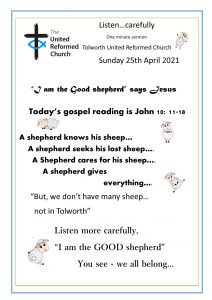
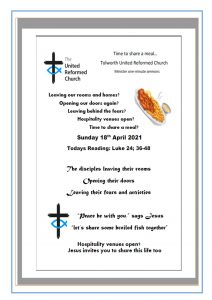
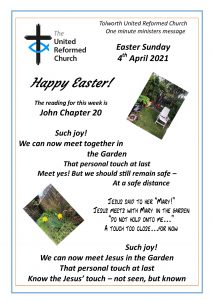
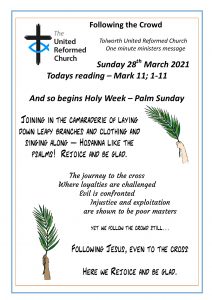
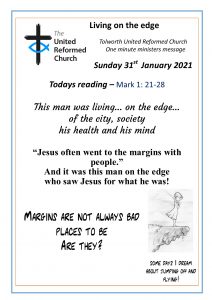
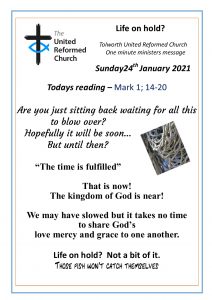
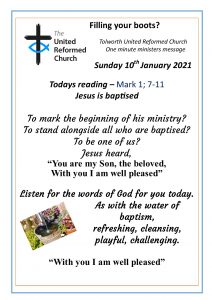
One minute sermons displayed on the Church Notice board during the COVID-19 crisis.

……….………………..

Sermons

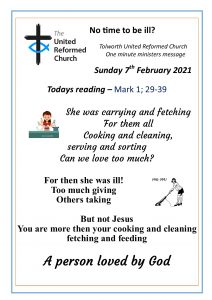
Mark 1; 29-39 Peter's Mother -in-Law

Mark 1; 29-39 Peter’s mother-in-law


“Boy,” I think, with some annoyance, “When that daughter and son–in-law of mine get home I’m going to show em!”


They think this is all I’m good for!  Serving up a few meals when they want it.    I’ll show them.  When I’m better, when I get my strength back I’ll show em!  But my bones ache so.  I just want to lie down and rest all the time!  They left me in bed this morning, that daughter and son-in-law of mine.  But how can I stay in bed with all this work to do.  When I’m better and get my strength back – that’s when I’ll tell em.

That son-in-law of mine, good-for-nothing if its not out fishing for all the hours God sends, he’s off following that preacher bloke to goodness knows where.  What about my daughter eh!  That’s what I ought to tell him.  Leaving her to fend for the kids and clearing the house up and washing those filthy, fish-smelling cloths of his.  That’s what I ought to tell him.  When I get my strength back – that’s when I’ll tell em.  That’s when I’m going to show em.

Mind you, she’s not much better!  She comes home complaining about him – Peter this and Peter that!  Wants my shoulder to cry on then O yes!  How he ‘s always leaving her with the children, doesn’t know where he is half the time.  Of course she has to wash and clear up after him – that’s her job isn’t it – don’t come winging to me.  That’s not all I’m good for either.  Yes that’s when I’m going to show em.

O how my bones ache so.  How I am so tired. I just want to rest.  Lie down and let the world go on around me, just for a while, please.  It’s so hard.  I feel like this, death warmed up – but I still have to get that water on the boil and get the vegetables peeled – that’s the job I hate most when I feel like this.  I’ have to sit down and do it when I’m feeling this tired.  And then their kids start crying and wanting to play or something to eat!  I can feel myself getting irritable – and its not their fault – I know, but well you just take it out on them.  What is she leaving me with their children for anyway!

How can I go on like this?

Eventually I can’t take it anymore, I just lay down, close my eyes.  Just a few moments sleep, just a few moments.  And I sleep!

Then I felt his hand upon me – his hand touched mine and slowly tightened.  As I opened my eyes and tried to focus I saw his eyes looking into mine.  I glanced just beyond him and Peter and the others were standing by the door, just watching.  I briefly noticed my daughter had gone to the children.  But my gaze quickly returned to the man whose hand was holding mine. He gently lifted me until I was standing.

I can tell you, usually when I’ve had a fever like this it takes sometime to shake it.  Usually I’m up working again, before I’m better still tired and aching but knowing that I have to keep going. You have to don’t you?   Not this time. No not this time. Once I was standing I immediately felt the strength surge through my body – I felt stronger – strong enough again and began getting them all seated around our large dinner table.  I was so excited that I could again begin to do the thing I enjoyed – the thing I liked doing best, serving them all with a good meal.  First with a few drinks while they sat and talked and then heating up the meal, passing the plates and making jokes.  Then scooping out the food and putting onto their plates and watching them as they eat, joining in their easy talk. Getting the feel of pride as they comment on how good it is.

Then I want to tell them.  To show em.  This is not all I can do you know.  I can do more than cook and serve up food.  It’s not just all this cooking and cleaning and looking after the children  that I am good at.   But I wanted to tell him first – the one who had held my hand and lifted me up.  So I took my moment.  As the talk quietened I went to stand beside him with a bowl of fruit.  I offered him the bowl and I was just about to speak and I into saw in his eyes – he knew.  I didn’t need to say it.  I didn’t need to him.  “This is not all I am good for.  Not all of who I am.  You see when the greatest praise I got growing up was – “you won’t get a peep out of her” or  “quiet as a mouse”.  So we kept our head down and got on with the housework thinking that is all we are good for.   But this cooking and cleaning doesn’t make me who I really am– I can enjoy it, sometimes, but I am so much more than all of this, and I could tell he knew.   And that convinced myself!

The others well sure I’d have to tell them at some point.  They think that this is all I am good for.  But not yet.  For now I wallow in the new found strength and confidence I have found.  And I didn’t tell him.   A short time later they had all left.

I heard later how so many, many more people were all finding their way to him looking themselves for strength and health.  Did they understand?  Was it just the curing of their diseases and ills they wanted and found?  Who knows?  Some must surely have looked into those eyes as I had done.  I so much wanted to ask but there wasn’t the time.

Early the next morning Peter and the others were gulping down their breakfast.  “He’s gone off on his own,” one said.  “to be alone I expect” said another.  “Doesn’t he know there will be crowds searching for him today.”  “Quick, lets go to find him, get him back”.   I told them! “Let him be,” I said,  “he must need some time alone.”  They didn’t listen. They woofed down their breakfast, grabbed their tunics and were gone.  “Whose going to clear up your mess?” I shouted after them, half smiling.  I have to face that one later.  But for now…

The next thing I hear is that he’s moved on.  He wasn’t staying around looking for favours or faint praise.  He had work to do.  He’d done his work here.  I could understand that.  He knew how I could carry on in my own small ways – and just serving others with food, although that was important.  There was so much more I could do

I am not sure if Peter understood.  Maybe he’ll grow up one day.  But I can understand why he wants to be with him – follow him and learn from him.  Whatever the future holds for them.

“Peter will be back,” I tell my daughter and I think she understands too.  And she’ll keep nipping off to be with him when she gets the chance.

That means I still do lots of cooking and looking after the kids.  And mostly I enjoy it.  I still get tired of course.  And I get fed up with the cooking and cleaning.  I’m still left with the kids.  And when I get ill again its still a struggle to keep going.  But it is different now.  I know it’s not all I’m good for.  I know there is so more to me.  There is more of who I am waiting to get out everyday.

And “Boy,” I think, laughing this time, “when that daughter and son–in-law of mine get home – yes then I’m going to show em.”

John 20; verses 19-31 Think you know me…well I'm Thomas?

John 20; verses 19-31 Think you know me…well I’m Thomas?


You think you know me don’t you?  You think you’ve got me sussed. We like to think that about others don’t we?  Sum people up by one thing that they have said or done.  Well I thought it was about time I set the record straight.  Think you know me?– I don’t think you know me at all.  All these years you’ve using my name in some derogatory fashion, or worse still with some kind of patronising humour.

“Doubting Thomas”  and then snigger.  Or “doubting Thomas” and a shake of the head, “poor ol’ doubting Thomas”.  Well I don’t want your sympathy.  I don’t even need your sympathy.  In fact I didn’t do anything wrong.  True I questioned the other disciples. True I said I wanted to see Jesus for myself.  True I even said wanted to touch his wounds.  But,  I am telling you now it was nothing to be ashamed of.  In fact, it’s a shame a few more people don’t ask a few more questions.  Yes, challenge a few of the people telling us what to believe.  Not just take everything because it says it here or there or so and so told me that!  No I am here to let you know,  you need to ask some of the difficult questions.  People won’t like it of course.  They’ll think you causing trouble, being difficult, probably call you a “doubting Thomas” or “doubting Theresa”. But don’t worry.  You know, Jesus didn’t!

No I am here to put the record straight.  I wasn’t doubting Jesus or questioning God,  NO!  I was doing exactly what Jesus had been teaching – trying to see and believe!

Now think about me for a minute!  May be you think I was frightened, scared at the thought that Jesus was alive again and all ready to run a mile from a ghost!  Or, frightened that if, we started talking about Jesus being alive again, then the Romans or religious authorities would come and get us.  Well you can think again.  Remember when Jesus said, “lets go back to Bethany to Lazarus”?  All the rest said to him, “Ooo, no it was too dangerous”, “they tried to stone you there Jesus, you don’t want to walk back in to that again”   Who was who said,  “let us go with him and face the music by his side”.  Yep, yours truly!  I wasn’t frightened then and, for your information, I was not frightened in that room!

If you said the others were frightened, well I might not argue.  Remember when Jesus first appeared to the disciples.  They were all frightened and had locked themselves away.  And me!  Well I wasn’t there was I?  If I had have been there I have seen him with the others.    No, when they were all hidden and locked away, I was out, walking the streets, trying to find out what was going on.  That is not the action of a frightened man. That is the action of a….an “action man” if you ASK ME!    No I wasn’t frightened.  It wasn’t fear that led me to question the others when they said they had seen Jesus.

I wasn’t scared of a  ghost or goolies ( I could watch your DrWho with out going behind the couch anyday) and I wasn’t scared of the authorities either.  NO you had better try again if you think that that was the reason I would not believe until I saw the marks on his hands and his side. Incidentally how did I know he had the wound in his side?  I’ll tell you I was there when Jesus was being crucified.  The others were hiding, apart from the women of course, and I didn’t get as close to him as they.  They’ve got more guts the rest of us put together. But I did go and I saw him die.  That wasn’t the action of a frightened man either.

I suppose I was always asking questions.  Like…when… we were all sitting around the dinner table that last night.  Jesus told us we would not be able to follow him where he was going.  Well, I asked him straight out.  “ How can we follow you if we don’t where you are going”.  I didn’t really understand what he was saying. No I grant you that.  Some of those things he was saying were a bit confusing.  But Jesus was telling us to ask questions and think for ourselves- even be ourselves.  I loved his stories – you know – those ones when he didn’t tell us all the answers to!  He just left us hanging on the punch line.  He was wanting us to go away and think about what he had just said.  Not to just believe with unquestioning acceptance.

You know, I get quite exasperated sometimes with all those people who just accept what is said to them, “because you must to have faith”. They hear things about God and blindly accept without wondering and exploring what God might really be saying and doing. Some really clever people too!  It’s like they leave their brains at home when they start speaking about God.  I mean lets face it,  when you think about the awesome claims that Jesus made about faith, you have to…well think about it don’t you.

You see I wasn’t about to rely blindly on what others were saying about Jesus.  Or more importantly even, I just couldn’t believe that after all those awful events that previous week, that faith could be so trivial.  My heart wanted to believe of course it did, but my mind would not allow it.  and from what I remembered about what Jesus had said and did, faith was no trivial for him either.  The God that Jesus showed to me demanded that I use my heart and my mind, the way Jesus had taught us.  Jesus had taught us about a God who was concerned about my heart and my feelings, but also about my mind and my real experience too.  So there I was. I wasn’t about to believe just because others said so. Or because it simply felt good and I wanted to believe it.  That was too easy and faith is not that easy.  And asking to see his hands and touch his wounds?  That wasn’t about wanting proof, or signs or miracles.  It wasn’t about seeing to believe.  It was about seeing and believing.

When eventually it happened.  When Jesus was there in front of me.  Sharing his own peace with us, well… I knew about his wounds sure.  He invited me to prove it to myself, by touching those wounds.  I think he knew I wouldn’t touch him.  He knew that the moment I attempted to touch his hands or his side for proof, he would just disappear, because it would no longer be an act of faith.  All I could do at the moment was recognise Jesus as the Lord we had known on earth, and then recognise the very God in whom I could have faith.  I actually said it didn’t I.  “My Lord and my God”.

So I just want to put the record straight.  You see I am a lot like you really.  I wasn’t there at the beginning when Jesus first appeared after the crucifixion.  And I couldn’t have faith from signs and miracles or see them as proof.  That wouldn’t be any faith at all.

But I did want my faith to be real.  That is not going to make me frightened to face to the world. Is not going to rely signs and miracles.  The kind of faith stands up to questions and challenges and deepens when I ask the questions and make the challenges.

So when you think about me again.  When you snigger and say “poor o’ doubting Thomas”.  You think about yourself.  And ask your questions and face your doubts.  You see I’ve put the record straight now.   See how your faith can deepen just like mine!

(c) 2026 Tolworth United Reformed Church – Powered by WordPress, Designed by Theme Blvd, Website by iChurch

Tolworth United Reformed Church
x
Top
Everyone is welcome here at Tolworth United Reformed Church.
We use cookies to ensure that we give you the best experience on our website. If you continue to use this site we will assume that you are happy with it.